Eduqas · GCSE · English Language
Comparing texts: comparing two or more texts critically with respect to the above
This topic tests your ability to critically compare writers' ideas, perspectives, and methods across two unseen texts (AO3). You must identify differences in viewpoint and evaluate how language, structure, and tone are used to influence the reader.
- 6 min read
- 3 worked examples
- 5 practice questions
- 8 key terms
Study Notes
Overview
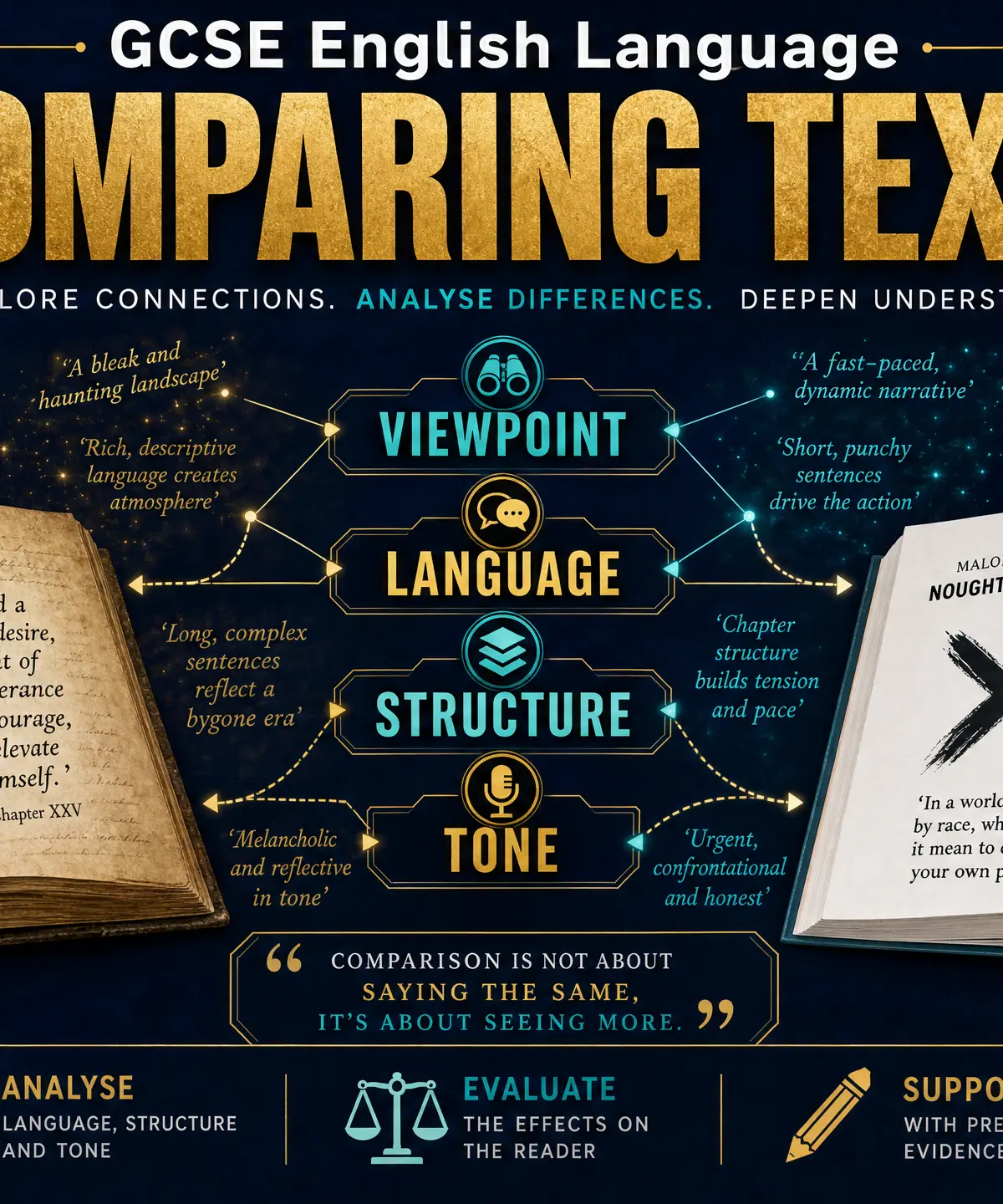
Comparing texts is a high-tariff skill in GCSE English Language. It requires you to look at two unseen texts—often from different centuries—and evaluate not just what the writers are saying, but how they are saying it. This targets Assessment Objective 3 (AO3): comparing writers' ideas and perspectives, and how these are conveyed. You must act as a critical reader, moving beyond simple similarities to explore nuanced differences in tone, structure, and linguistic choices.
Reading Skills
Identifying Information & Ideas
Before you can compare, you must comprehend. When approaching two texts, begin by establishing the fundamental 'who, what, where, when, and why'.
- Explicit Information: Facts directly stated in the text (e.g., 'The train was delayed by two hours').
- Implicit Information: Ideas suggested but not directly stated (e.g., 'The passengers checked their watches and sighed heavily', implying frustration with the delay).
Examiners award marks for selecting precise, relevant evidence that directly answers the question focus.
Analysing Language
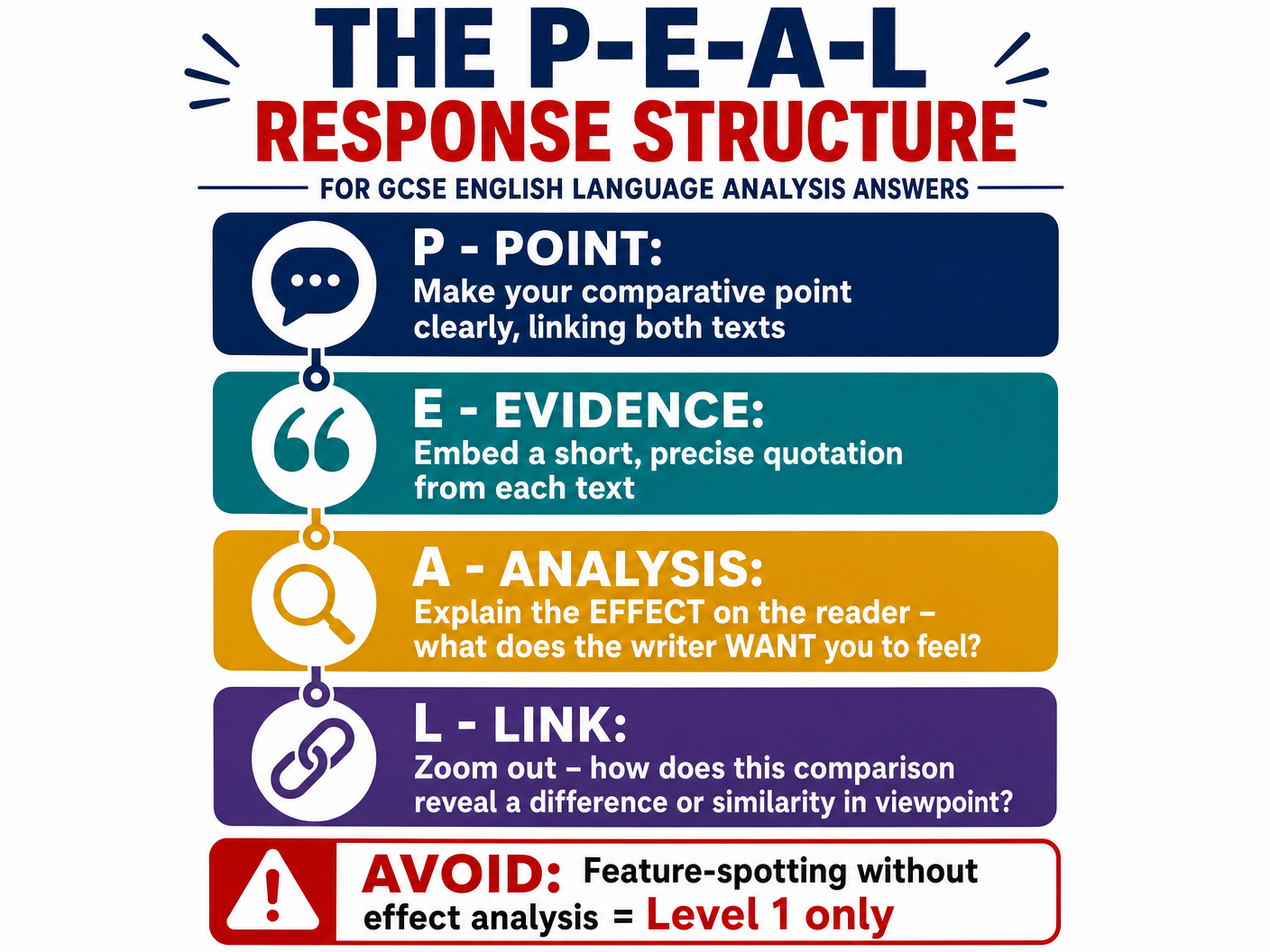
When comparing texts, you must identify language features and, crucially, analyse their effect on the reader. Feature-spotting alone limits you to Level 1.
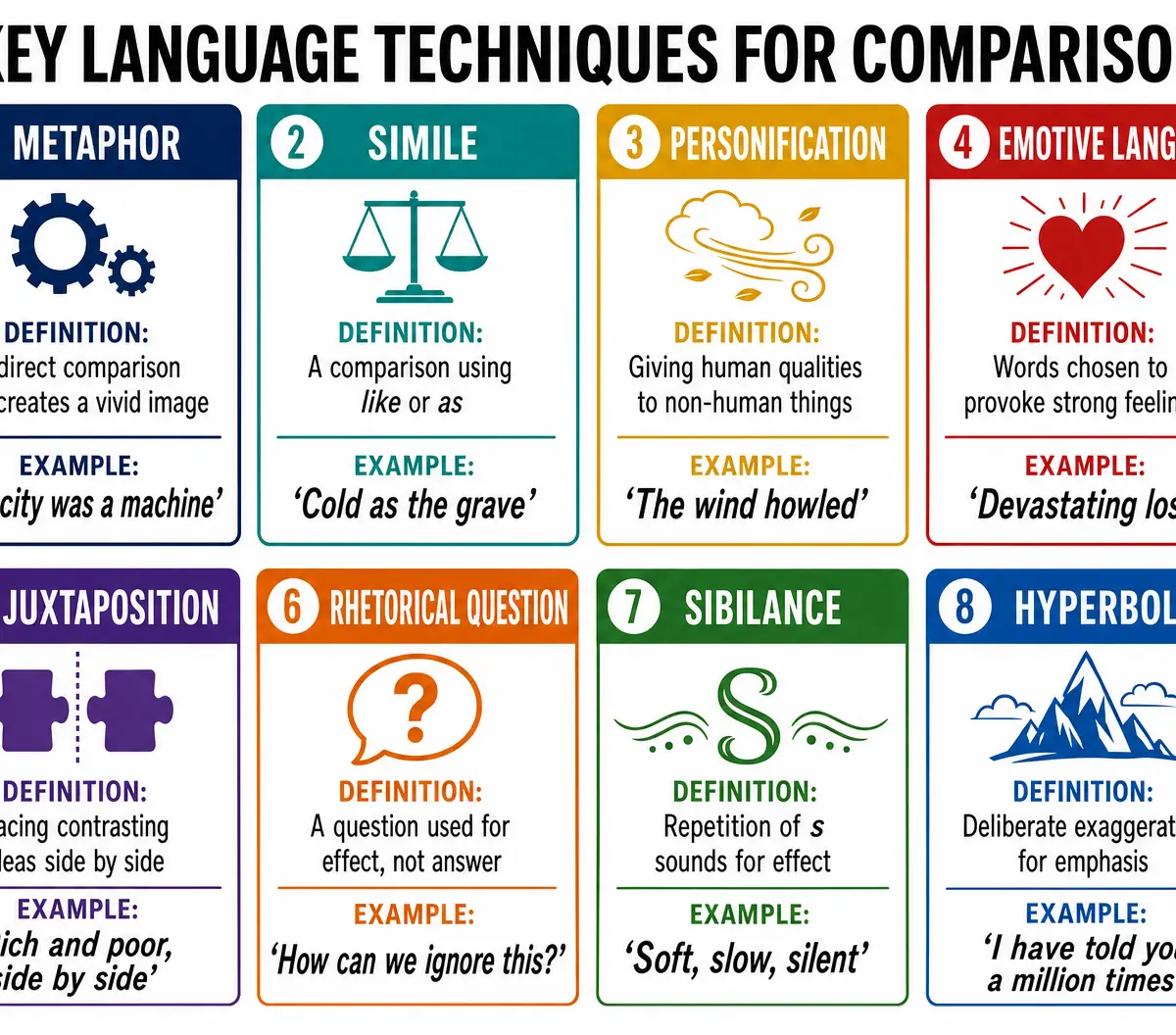
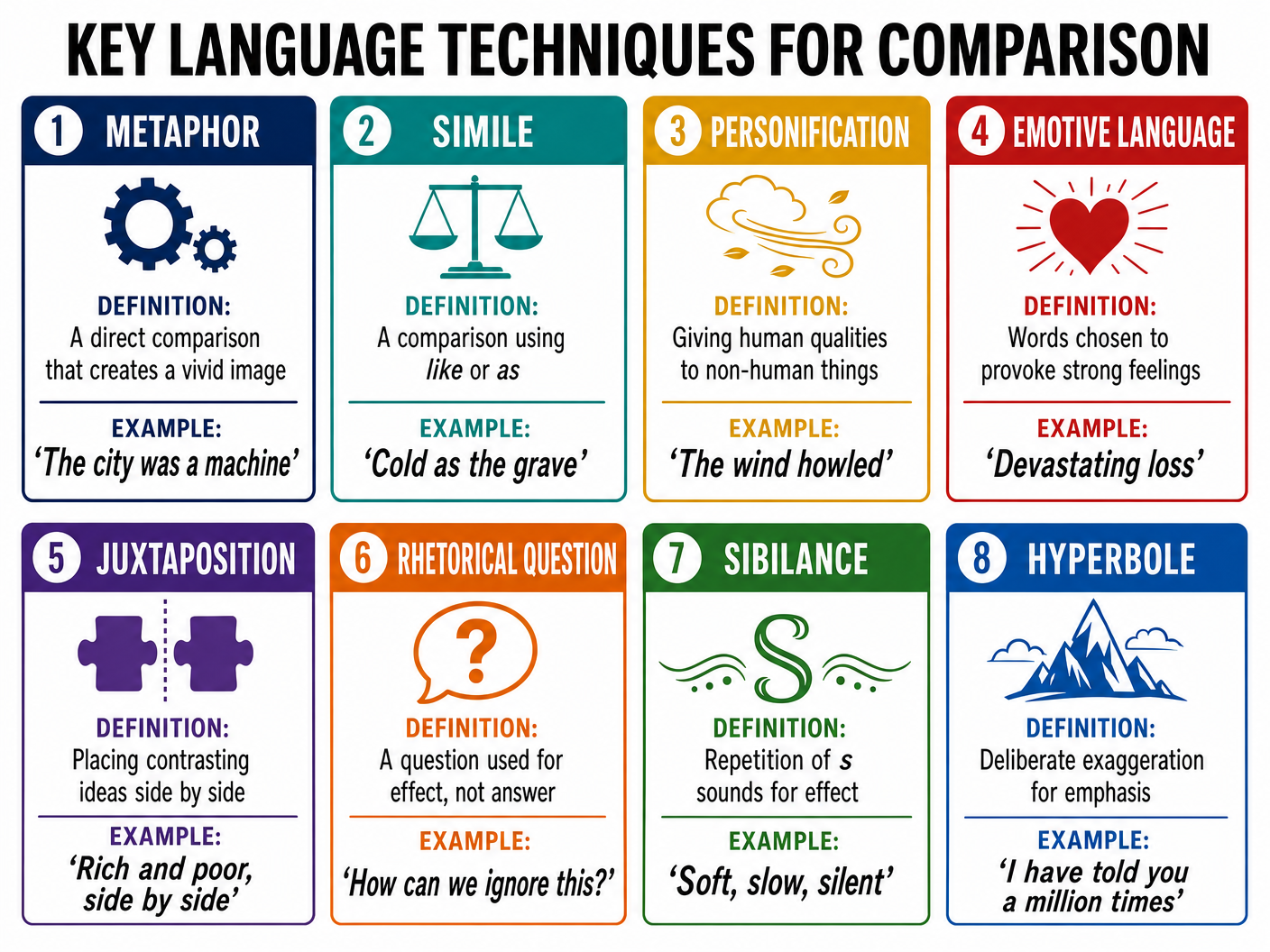
Key Language Features to Identify
| Feature | Definition | Effect on Reader | Example |
|---|---|---|---|
| Metaphor | A direct comparison stating one thing is another. | Creates a vivid, striking image that deepens understanding. | 'The city was a machine.' |
| Simile | A comparison using 'like' or 'as'. | Helps the reader visualise a concept by linking it to something familiar. | 'Cold as the grave.' |
| Personification | Giving human qualities to non-human things. | Brings inanimate objects to life, often creating atmosphere or threat. | 'The wind howled.' |
| Emotive Language | Words deliberately chosen to provoke strong feelings. | Manipulates the reader's emotions (sympathy, anger, fear). | 'Devastating loss.' |
| Juxtaposition | Placing contrasting ideas side by side. | Highlights differences and creates tension or irony. | 'Rich and poor, side by side.' |
| Rhetorical Question | A question asked for effect, requiring no answer. | Engages the reader directly, forcing them to consider a viewpoint. | 'How can we ignore this?' |
| Sibilance | Repetition of 's' sounds. | Can create a soft, soothing effect, or a sinister, hissing tone. | 'Soft, slow, silent.' |
| Hyperbole | Deliberate exaggeration for emphasis. | Dramatises a point to ensure the reader grasps its magnitude. | 'I have told you a million times.' |
Analysing Structure
Structure is the architecture of the text. Comparing how two writers organise their ideas is a hallmark of a Level 4 response.
- Openings and Endings: Does the text begin in media res (in the middle of the action) to create urgency? Does it end on a cliffhanger or a satisfying resolution?
- Shifts in Focus: Track the writer's 'camera lens'. Do they move from a wide landscape description to a narrow, personal detail?
- Sentence Variation: Short, punchy sentences build tension and pace. Long, complex sentences (often found in 19th-century texts) can reflect a reflective, descriptive, or formal tone.
- Paragraphing: Are ideas broken into brief, fragmented paragraphs to suggest chaos, or long, cohesive blocks to present a reasoned argument?
Evaluating Critically
Evaluation (AO4) asks for your informed opinion on how well the writer has achieved their aim. You must state a clear viewpoint and support it.
- Statement: 'The writer successfully creates a sense of panic...'
- Evidence: '...through the use of fragmented syntax: "No time. Must run."'
- Analysis: 'This forces the reader to read at a breathless pace...'
- Link: '...which perfectly captures the chaotic environment of the scene.'
Comparing Writers' Viewpoints
This is the core of AO3. You must use a structured approach to compare the texts.
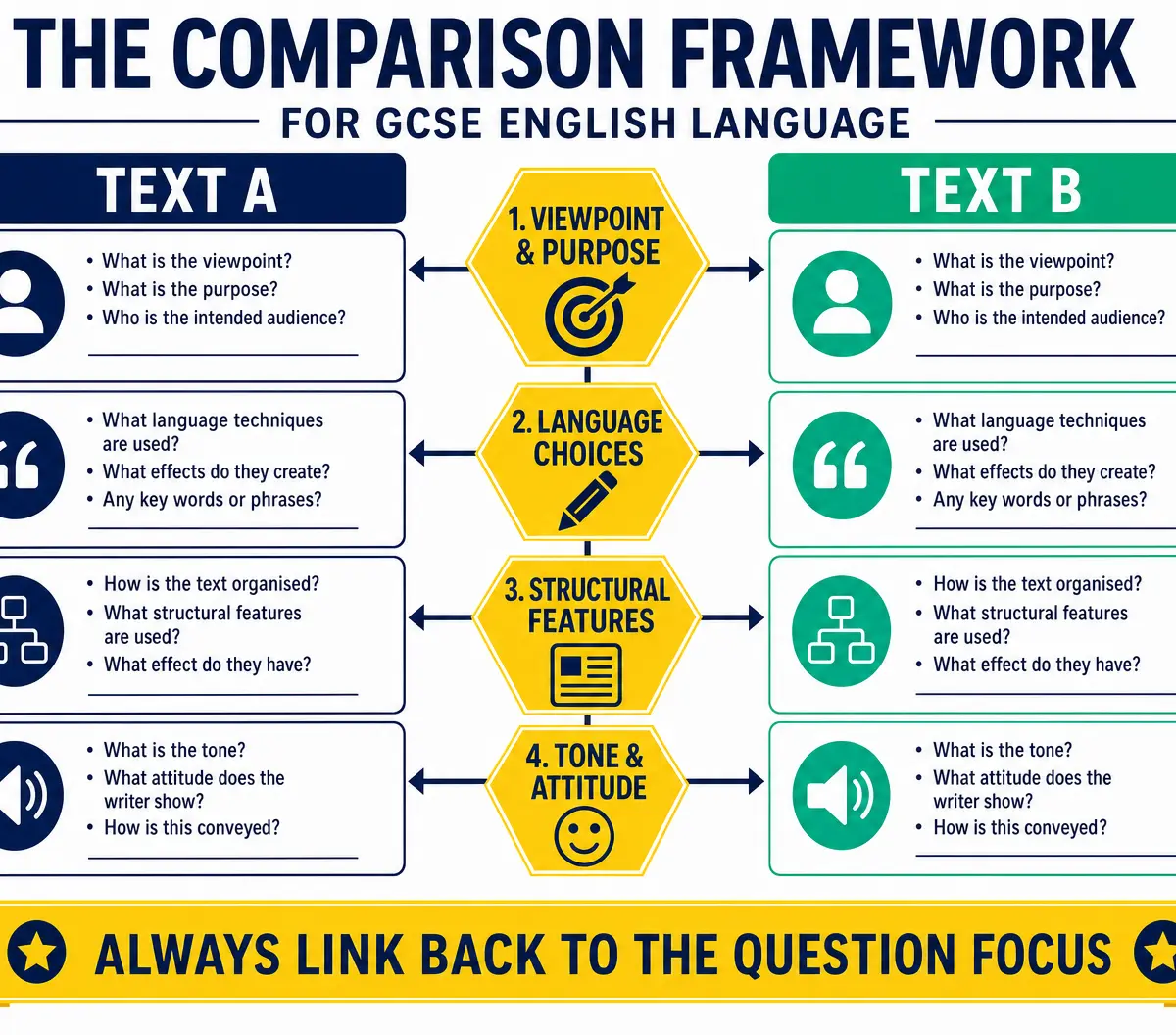
- Identify Viewpoints: What is each writer's attitude toward the subject?
- Compare Methods: How does Text A convey this attitude compared to Text B? (e.g., Text A uses statistical facts; Text B uses emotive anecdotes).
- Evaluate Effectiveness: Which method has a stronger impact on the reader, and why?
Always use comparative connectives: similarly, whereas, in contrast, on the other hand, conversely.
Writing Skills
Creative Writing
When asked to write a narrative or description, treat the reading texts as models.
- Show, Don't Tell: Instead of 'He was angry', write 'His fists clenched until the knuckles turned white.'
- Sensory Description: Engage sight, sound, smell, touch, and taste to build a 3D world.
- The One-Scene Rule: For a 45-minute exam, do not try to write an epic novel. Focus on one setting, one short timeframe, and one main event. Depth is better than breadth.
Transactional/Non-Fiction Writing
You may be asked to write a letter, article, speech, or leaflet. Always establish the P-A-F (Purpose, Audience, Form).
- Purpose: Are you arguing, persuading, advising, or informing?
- Audience: Are you writing for teenagers, adults, a headteacher, or the general public? This dictates your register (formal vs. informal).
- Form: Ensure you use the correct conventions (e.g., a speech needs a direct address 'Ladies and gentlemen'; a letter needs a formal sign-off).
Use the AFOREST techniques to build persuasive power.
Technical Accuracy (SPaG)
Spelling, Punctuation, and Grammar (SPaG) account for up to 20% of your writing marks (AO6).
- Ambitious Punctuation: Move beyond commas and full stops. Use semicolons to link related independent clauses; use colons to introduce lists or dramatic statements; use dashes for emphasis.
- Paragraph Cohesion: Use discourse markers (Furthermore, Consequently, Nevertheless) to link paragraphs logically.
- Proofreading: Always leave 5 minutes to check for careless errors in basic spelling and sentence demarcation.
Listen to the Podcast
For a deep dive into the four lenses of comparison and how to structure a top-tier response, listen to our dedicated podcast episode:
Visual Resources
3 diagrams and illustrations
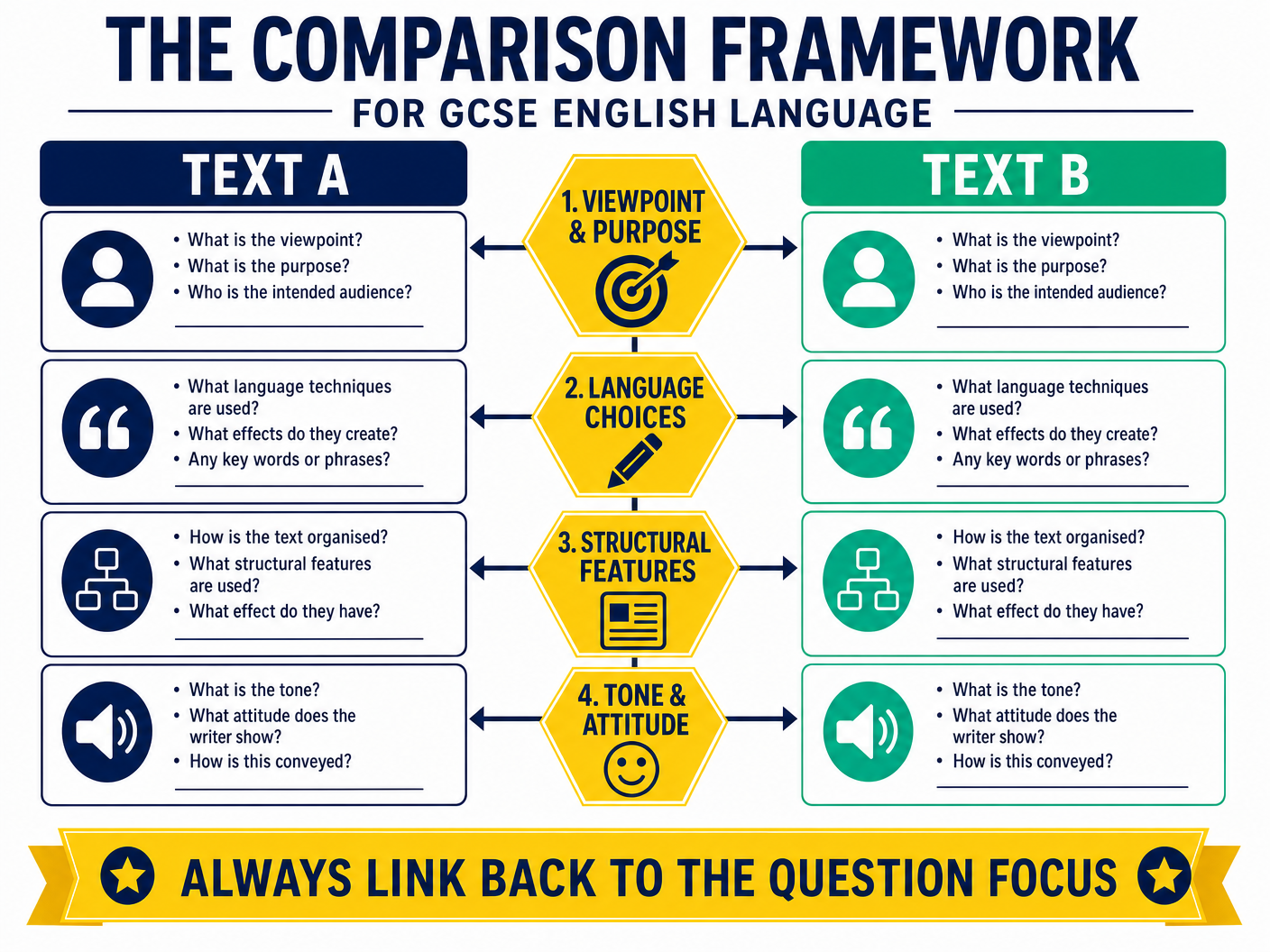
Interactive Diagrams
2 interactive diagrams to visualise key concepts
Conceptual Flow Outline
Step-by-step approach to a comparison question
Conceptual Flow Outline
Cyclical process of writing a comparative paragraph
Worked Examples
3 worked examples — open one to explore the question and available guidance.
Practice Questions
Test your understanding — click to reveal model answers
Read lines 1-10. List four things you learn about the narrator's journey.
Hint: Keep it simple. Find explicit facts. You do not need to write full sentences or analyse.
How does the writer use language in paragraph 2 to describe the heat?
Hint: Look for metaphors, similes, or strong adjectives. Explain how they make the reader feel the temperature.
Compare how the writers of Text A and Text B convey their perspectives on modern technology.
Hint: Use the VLST framework. Identify the viewpoint of each, then compare the language and tone they use to express it.
Write a description suggested by this picture: [An image of a busy, rain-soaked city street at night].
Hint: Focus on sensory details. Show, don't tell. Do not try to write a whole story with characters and plot.
Write an article for a broadsheet newspaper arguing that young people are too obsessed with fame.
Hint: Identify your PAF: Purpose (argue), Audience (adult broadsheet readers), Form (article). Use a formal register and AFOREST techniques.